Not every breast reduction patient comes in with the same size on both sides. This case shows a clear difference between the right and left breast before surgery, with the right side noticeably larger and fuller than the left. Correcting this kind of imbalance takes a different approach than a standard reduction, since each side needs its own surgical plan.
Spotting the Asymmetry
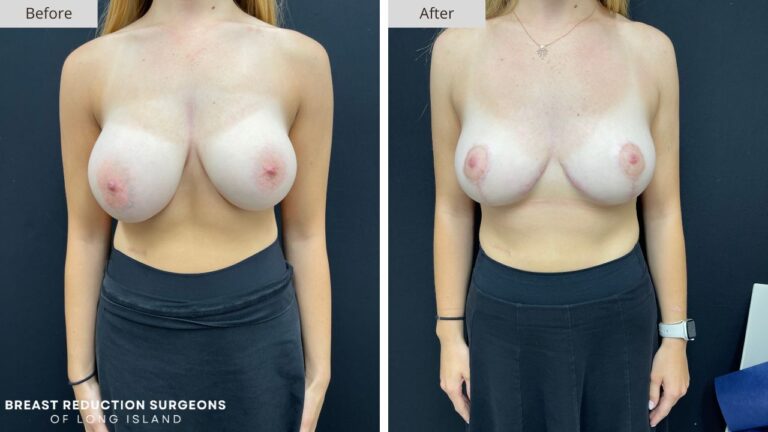
In the before photo, the right breast sits larger and more rounded than the left. The difference is visible in both the front and side views, with the right breast carrying more volume and a fuller lower pole. This kind of size difference between sides is common and shows up in a wide range of degrees, from subtle to more pronounced.
Breast asymmetry like this usually develops on its own, often becoming more noticeable during puberty or after weight changes. It is rarely caused by anything the patient did, and it does not mean anything is wrong. It simply means the two sides grew or developed tissue at different rates.
For this patient, the size gap between sides was clear enough that a standard reduction, removing the same amount of tissue from each breast, would not have solved the problem. Treating both sides identically would have left the imbalance in place, just at a smaller overall size.
Why Asymmetry Needs a Custom Surgical Plan
Correcting uneven breasts means tailoring the amount of tissue removed to each side individually. Our surgeon has to assess the volume, shape, and position of each breast separately, then plan a different resection for each one to bring both sides into balance.
This is more complex than a standard reduction, since the goal is not just to make each breast smaller. The goal is to make both breasts match each other in size, shape, and position once swelling resolves. That means the larger breast typically needs a greater volume of tissue removed, while the smaller side may need a more conservative approach to avoid overcorrecting in the other direction.
Nipple-areola position also has to be evaluated on each side. If one breast has dropped lower due to its larger size, the nipple-areola complex on that side often needs to be repositioned to a different point than the other side, so the final result looks even rather than mismatched.
What the After Photos Show
The after photos show a much closer match between the right and left breast. Both sides now sit at a similar height on the chest, with comparable volume and a matching lower pole shape. The visible size gap from the before photo is no longer present.
This kind of result comes from treating each breast as its own surgical case within the same procedure. Rather than applying one plan to both sides, our surgeon adjusted the resection and shaping for each breast individually, based on what that specific side needed to match the other.
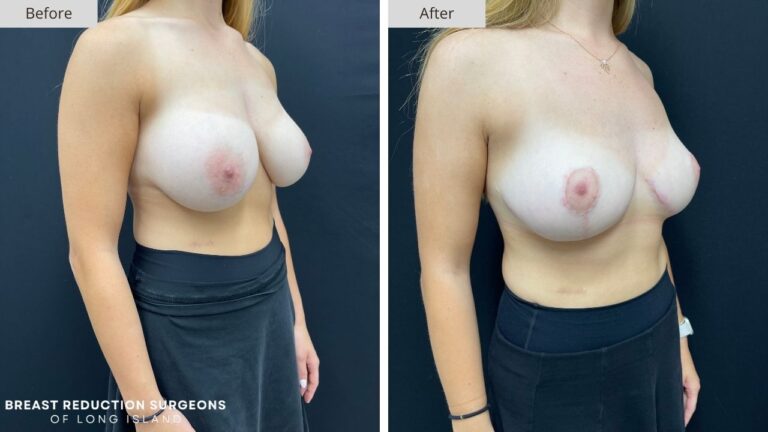
The side profile photos also reflect this balance. Both breasts now project at a similar distance from the chest wall, with a consistent shape from the front through to the side view. This kind of symmetry is harder to achieve than a standard bilateral reduction, since it depends on getting both the volume and the shaping right on each side independently.
The Result
This patient’s after photos show two breasts that are now closely matched in size, shape, and position. The fullness that previously stood out more on the right side has been brought in line with the left, creating a balanced overall appearance. The nipple-areola complex sits at a consistent height on both sides, and the lower pole shape is even from one breast to the other.
This kind of outcome reflects careful planning rather than a one-size-fits-all approach. Asymmetry cases require extra attention to detail throughout the procedure, since small differences in resection or shaping can leave a visible gap in the final result if they are not accounted for ahead of time.
If You Have Noticed a Size Difference Between Sides
Breast asymmetry is more common than most people realize, and it is a valid reason to consider reduction surgery on its own, even without significant overall size concerns. If you have noticed one breast sitting larger, fuller, or lower than the other, a customized surgical plan can address that imbalance directly.
Every asymmetry case is different, and the right approach depends on the specific size and shape difference between your two sides. If you are dealing with uneven breasts and want a more balanced result, we encourage you to contact Breast Reduction Surgeons of Long Island for a consultation. Our team can evaluate your case and build a plan suited to your anatomy.