A Starting Point That Called for Major Correction
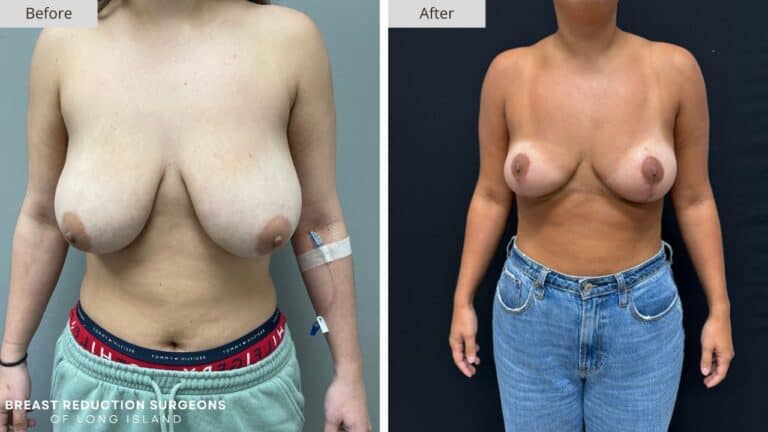
This patient came to us with a level of breast volume and sagging that goes beyond what a lift alone can fix. In the before photos, the breasts sit low on the chest wall, with the nipple-areola complex positioned well below the natural breast fold. This is a classic sign of severe ptosis combined with significant volume.
Cases like this stand out right away. The weight of the tissue stretches the skin envelope over time, which pulls everything downward. At this stage, reduction surgery has to do two jobs at once. It needs to remove enough tissue to relieve the weight, and it needs to reposition the remaining tissue and the nipple-areola complex so the breast sits where it should on the chest.
Why Volume and Position Both Need Attention
When breasts reach this size, the problem is not just about how much tissue is there. It is also about where everything has shifted. The skin has stretched past the point where it can hold the breast in a natural position on its own.
For a case like this, our surgeon has to remove a substantial amount of glandular tissue and fat while also reshaping the internal support structure. This is different from a smaller reduction, where the focus is mostly on contouring. Here, the priority is correcting the drape of the tissue and lifting the nipple-areola complex back to a natural position on the breast mound.
We typically approach significant cases like this with an anchor-shaped incision pattern. This pattern gives access to remove larger volumes of tissue and allows for precise repositioning of the nipple-areola complex. It also lets us reshape the lower pole of the breast, which tends to be the most stretched and least supportive area in cases of severe ptosis.
Addressing the Nipple-Areola Position
One of the clearest signs of severity in the before photo is how low the nipple-areola complex sits relative to the breast fold. In a healthy, well-supported breast, the nipple sits at or above the fold. When it drops well below that line, it tells us the support structures inside the breast have given way under the weight of the tissue.
Correcting this requires more than just trimming skin. The nipple-areola complex has to be surgically repositioned on a vascular pedicle that keeps its blood supply and sensation intact. This step is technically demanding in larger cases since there is more tissue to work around and a greater distance to move the complex.
In the after photos, the nipple-areola complex sits in a much higher, more natural position on the breast mound. This shift is a direct result of that repositioning work, not just the reduction in size.
The Result
The after photos show a breast that is smaller, lifted, and proportional to this patient’s frame. The lower pole no longer shows the stretched, deflated look that was present before surgery. The nipple-areola complex now sits in a position consistent with a natural breast contour, and the overall shape has a fuller, more supported appearance despite the reduction in volume.
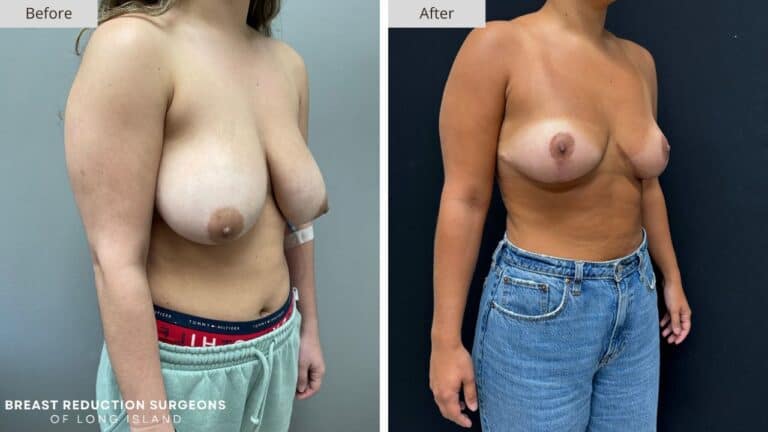
The side profile photos also show a meaningful change in projection. Before surgery, the breast tissue extended forward and down due to the weight pulling it away from the chest wall. After surgery, the breast sits closer to the chest with a rounder, more youthful profile.
This kind of result is typical when a significant reduction is paired with proper repositioning of the nipple-areola complex. Removing tissue alone would not have corrected the ptosis. The lift component of this surgery is what gives the breast its new shape and position.
Considering Breast Reduction for Severe Sagging or Size
If your breasts have reached a point where the weight feels unmanageable, or if you notice the kind of low nipple position seen in this case, you may be dealing with the same combination of volume and ptosis. This is common in patients who have carried significant breast volume for years, and it often gets more pronounced over time without surgical correction.
A reduction at this stage is not just a cosmetic decision. It can relieve physical strain on the neck, back, and shoulders while also restoring a shape that feels proportional to your body. Every case is different, and the right surgical plan depends on your specific anatomy and goals.
If you are dealing with significant breast size, sagging, or both, we encourage you to reach out to Breast Reduction Surgeons of Long Island for a consultation. Our team can evaluate your case and walk you through what a customized surgical plan would look like for you.