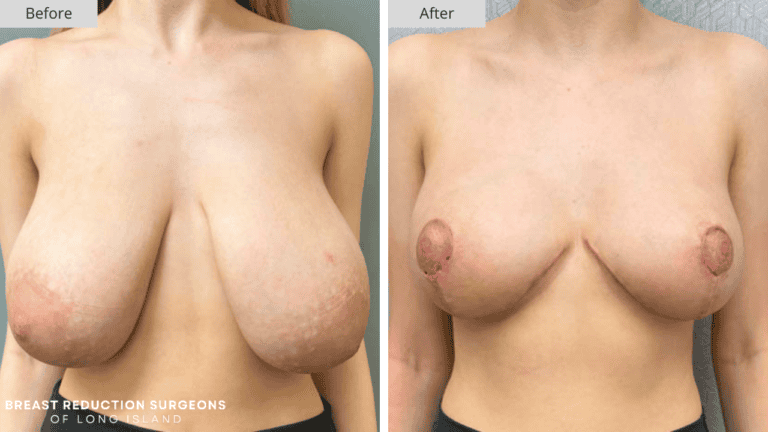
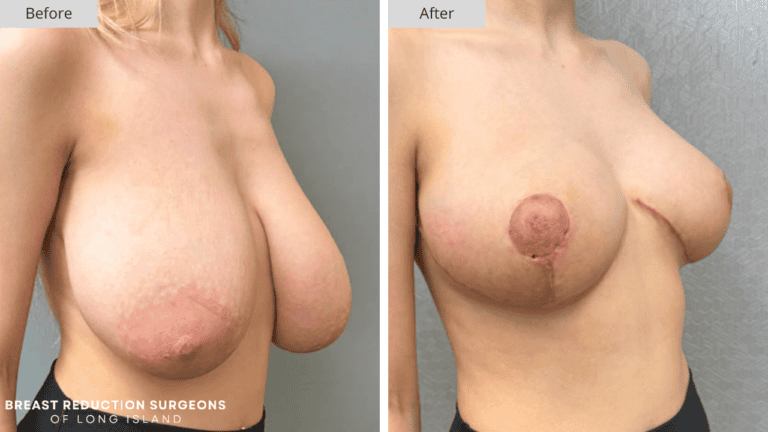
Scarring is one of the most common concerns we hear from patients considering breast reduction. This case is a good example of what scars look like in the months after surgery, before they have had time to fully mature. The before photos show extremely large, elongated breasts, and the after photos show both the dramatic reduction in size and the early stage of the scars that made it possible.
A Significant Reduction with Early Scarring Visible
The before photos show breast tissue that hangs well below the natural fold, with a stretched, elongated shape on both sides. A reduction of this size requires a longer incision pattern to remove enough tissue and reshape the breast mound. The after photos show this incision pattern clearly, with scarring around the areola and extending down toward the breast fold.
At this stage, the scars appear pink and slightly raised, which is normal and expected. Scar tissue goes through a predictable healing process, and the appearance seen here represents an early point in that process rather than the final result.
Why Larger Reductions Need Longer Incisions
The amount of scarring in any reduction is tied directly to how much tissue and skin needs to be removed. For a case like this, where the breast tissue is significantly enlarged and elongated, a shorter incision would not provide enough access to remove the necessary volume or reshape the breast properly.
Our surgeon uses an anchor-shaped incision pattern for cases like this one. This pattern includes a circular incision around the areola, a vertical line down to the breast fold, and a horizontal line along the fold itself. This combination allows for significant tissue removal, reshaping of the lower pole, and repositioning of the nipple-areola complex, all of which were needed here.
While this incision pattern leaves more scarring than smaller techniques, it is the right choice when the starting volume is this large. Attempting to use a shorter incision on a breast this size would limit how much correction is possible and could compromise the final shape.
How Scars Change Over the First Year
Scars from breast reduction follow a fairly consistent healing pattern. In the first few months, scars are typically pink or red and can feel slightly firm or raised to the touch. This is what is visible in this patient’s after photos. The scar tissue is still active during this stage, which is part of why it looks more prominent than it will later on.
Over the next several months, scars gradually fade in color and begin to flatten and soften. Most patients see significant improvement in the appearance of their scars between six months and a year after surgery. The vertical and horizontal lines tend to become thinner and less noticeable as the skin continues to remodel itself.
Scar appearance can vary from patient to patient based on skin type, genetics, and how well post-surgical care instructions are followed. Keeping incisions protected from sun exposure and following any scar care guidance from our team can support a smoother healing process.
The Result
Even with scarring still in an early, visible stage, this patient’s after photos show a major change in breast size and shape. The breast tissue is significantly reduced, the nipple-areola complex sits much higher on the chest, and the overall contour is rounder and more proportional than before surgery.
The scars themselves, while still pink in these photos, follow a precise pattern that will continue to improve in appearance over the coming months. The trade-off of visible scarring in the short term is what allowed for this level of correction in a breast that started out this enlarged.
What to Know About Scarring Before Surgery
If scarring is a concern for you, it helps to understand that the appearance of scars right after surgery is not how they will look long term. Scars from breast reduction generally continue to fade and flatten for up to a year or more after the procedure.
The right incision pattern for your case depends on your starting size and the amount of correction needed. Larger reductions typically require more extensive incisions, while smaller cases may be candidates for less invasive techniques. If you want to understand what your own scarring and recovery might look like, we encourage you to contact Breast Reduction Surgeons of Long Island for a consultation. Our team can walk you through what to expect based on your specific anatomy.